Practical Guide June 15, 2026 7 min read By Isnaad Team
Choose Your Smart Logistics Partner

From "Packaging Chaos" to Peace of Mind

How to choose the right fulfillment partner for your store — and turn operational headaches into a professional sales machine.

Choosing a fulfillment company is no longer just about renting warehouse space — it's about choosing a strategic partner that removes operational headaches so you can focus on growth.

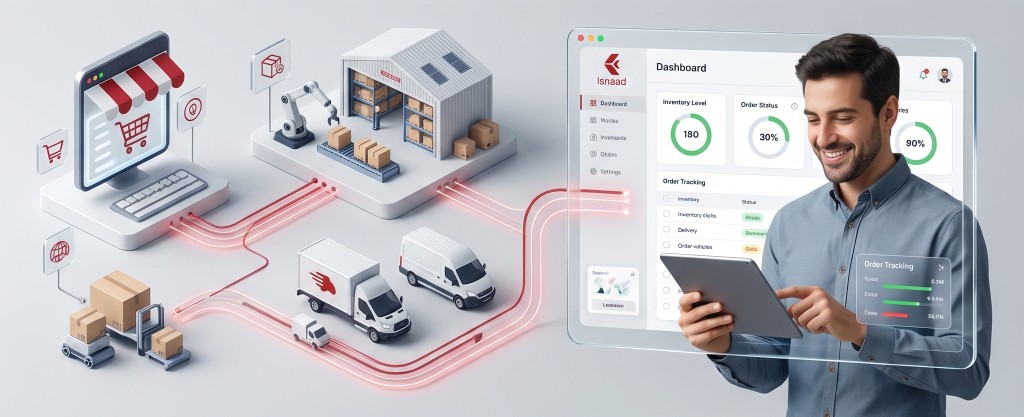
Choosing the best fulfillment company in Saudi Arabia — automated integration between store, warehouse and Isnaad dashboard

You launch a marketing campaign… and it absolutely takes off. Orders start pouring in nonstop. Exciting, right? But suddenly, you find yourself drowning in cardboard boxes, delayed shipments, inventory mismatches, and customer complaints piling up.

When Orders Explode… Your Operations Get Tested

This is where the difference appears between a merchant who is "managing chaos" and one who is actually "building a scalable business." Today's Saudi customer is fast, selective, and experience-driven. They expect lightning-fast delivery and premium packaging.

That's why choosing a fulfillment company is no longer just about renting warehouse space — it's about choosing a strategic partner that removes operational headaches so you can focus on growth.

A Warehouse Isn't Just Storage — It's the Engine Behind Your Store

Many merchants assume fulfillment simply means "store your products on a shelf." But fulfillment is much bigger than that. A professional fulfillment operation includes:

  • Receiving inventory from suppliers
  • Organizing and tracking stock accurately
  • Picking and packing orders immediately
  • Shipping products professionally
  • Managing returns efficiently

From the moment inventory enters the warehouse until it reaches your customer's hands, every step affects your brand reputation. And with Saudi Arabia's eCommerce market growing rapidly, businesses without strong logistics systems risk falling behind.

How Do You Know You've Found the Right Fulfillment Partner?

1. Automated Integration (Forget Excel Sheets & WhatsApp Orders)

If a fulfillment provider asks you to manually send orders through Excel spreadsheets… that's your sign to keep searching. Modern fulfillment depends on direct technical integration. Your store on platforms like Salla or Zid should connect directly with the warehouse management system through native integrations and smart automation. The moment a customer places an order:

  • Shipping labels print automatically
  • Warehouse teams begin processing instantly
  • Inventory updates in real time
  • Human error decreases dramatically

2. Location Matters More Than You Think

Your fulfillment partner's warehouse should be located near major logistics hubs. Strategically positioned warehouses in cities like Riyadh — and dark stores close to customers — allow for faster delivery times, lower shipping costs, and better last-mile efficiency. The goal is simple: a customer orders today… and receives their package before their coffee gets cold.

3. Transparent Pricing (No Surprise Fees)

Smart merchants calculate every riyal carefully. A trustworthy fulfillment partner should provide completely transparent pricing with no hidden operational charges.

ServiceWhat It IncludesWhy It Matters
Inventory ReceivingProduct inspection & countingEnsures inventory arrives correctly
Smart StoragePay only for used spaceAvoid renting oversized warehouses
Picking & PackagingProfessional packing processImproves customer experience & loyalty

Clear pricing helps you scale confidently without unexpected operational costs hurting your margins.

Why Fulfillment Is an Investment — Not an Expense

When you outsource logistics to professionals, you're not "spending money." You're buying back your time, focus, and operational stability.

Focus on Marketing & Growth

Instead of spending your day packing boxes and coordinating shipments, you can focus on acquiring new customers, improving products, scaling advertising campaigns, and expanding your business.

Stability During High Seasons

During massive sales periods like Saudi Founding Day, White Friday, and Ramadan campaigns, order volumes can explode overnight. A strong fulfillment partner should absorb that pressure smoothly without delays or operational breakdowns.

Fewer Returns & Operational Errors

With a proper Warehouse Management System (WMS), customers receive the correct order the first time, inventory remains accurate, return rates decrease, and operational losses shrink significantly. Efficient systems create happier customers and healthier profit margins.

Technology-Driven Partner

Isnaad: The Secret Engine Behind Your Store

Direct integration with Salla and Zid, warehouses near logistics hubs, professional picking & packing, and an accurate WMS that reduces returns — all at 99.9% accuracy.
500+
Saudi brands
99.9%
Pick accuracy
2h
Processing time
Explore Fulfillment Solutions
Isnaad automated integration and smart logistics operations

Final Thoughts: Don't Choose a Warehouse — Choose the Future of Your Store

At the end of the day, logistics is the real face of your business. Customers never see your office, your meetings, or your operational struggles — they only see the package that arrives at their doorstep.

Modern Saudi fulfillment companies are no longer just warehouses. They've become technology-driven partners helping brands compete at a professional level.

Maybe it's time to move your store into the era of automation, scalability, and professional fulfillment.

Tired of Running Between Shipping Companies?

Let us handle the operational details so you can focus on growth. Book your consultation now with Isnaad.

Book Your Consultation with Isnaad

No commitment • A specialist will reach out within 24 hours

Frequently Asked Questions About Fulfillment Companies

What's the difference between a shipping company and a fulfillment company?
A shipping company has one job: delivering packages from point A to point B. A fulfillment company does much more — they receive your inventory, store your products, process and package orders, handle shipping coordination, and manage returns and exchanges. In other words, fulfillment companies become an operational extension of your business.
When should I start working with a fulfillment company?
Usually when orders start increasing rapidly, packaging consumes most of your day, you want to expand into new regions, you need operational efficiency, or you want to focus on growing the business instead of handling logistics manually. That's often the moment when outsourcing fulfillment becomes necessary.
Can fulfillment companies handle fragile or temperature-sensitive products?
Yes. Many specialized fulfillment providers offer climate-controlled storage, refrigerated warehouses, protective packaging solutions, and fragile-item handling systems. However, before signing any agreement, make sure the provider has infrastructure specifically suited for your product category.

Read also

Five solutions, not one

Before choosing a company you choose a type of solution. The costliest mistake is rarely the wrong operator; it is the wrong route taken at the start.

Solution You pay for Fits Does not fit
Self-fulfilment from home or a small unit Your own hours Early stage · a few dozen orders a month · a product you need to handle yourself The point where packing becomes the job instead of building the store
Leased warehouse with your own team Fixed rent and salaries Large steady volume · special handling · operations as your competitive edge Volatile volume — the cost is fixed, the sales are not
Courier only Moving the parcel Merchants who prepare their own orders and need transport Merchants whose problem is storage and preparation, not transport
Marketplace fulfilment Marketplace commission and fees Sellers operating inside that marketplace who want its speed badge Brands built on their own storefront — the packaging and experience are not theirs
Independent fulfilment operator Each order fulfilled A growing own-brand store · volatile volume · packaging under its own name Very small volume · or operations being the edge itself

When Isnaad is not the right choice for you

A list a company is not supposed to write about itself. We write it because a partnership that starts on a bad fit ends quickly, and because knowing our limits is what makes our claims inside them believable.

Choosing a fulfillment partner: common questions

How do I choose a fulfillment company in Saudi Arabia?

Start with the type of solution, not the company name: self-fulfilment, a leased warehouse with your own team, a courier only, marketplace fulfilment, or an independent operator. Then within the type that fits you, compare four things: where the stock physically sits, whether it already integrates with your platform, how cost behaves when volume swings, and who carries the cost of a mistake.

When is self-fulfilment better than outsourcing?

When your volume is low and you are not about to grow, or when operations are your competitive edge — complex packaging, assembly on order, handling that cannot be delegated. Otherwise the hours spent packing cost more than paying someone to pack.

What is the difference between a courier and a fulfillment operator?

A courier moves a finished parcel from one point to another. An operator holds your stock, prepares the order, selects the carrier and receives returns. If transport is your problem a courier is enough; if storage and preparation are, a courier does not solve it.

How much does fulfillment cost in Saudi Arabia?

It varies by solution, not only by company. A leased warehouse is a fixed cost paid in a weak month as in a strong one. An independent operator's cost follows order volume, so it falls when sales fall. The right question is not «what is the price» but «what happens to this cost if my volume drops 40%».

What should I ask before signing?

Where the stock physically sits and which city it ships from · whether the integration with my platform is ready or needs development · how returns are handled and who pays reverse shipping · what happens at peak when my volume doubles · and who bears the cost when the wrong item ships.

Does the operator affect delivery speed?

Yes, but not the way people expect. Speed is set by where the stock sits before the order, not by transport after it. An operator holding your goods inside the city delivers in hours; one shipping from another city cannot, whatever carrier it uses.

Do I need inventory software?

Not if your stock sits with an operator. Inventory visibility follows whoever holds the goods, and stock levels sync back into your store platform. Buying a warehouse system makes sense for whoever runs the warehouse as their business.

When is a fulfillment operator not right for me?

If your product is bulky like furniture or carpets, if operations are your own edge, if you sell only inside a marketplace with no storefront, or if your volume is very low. See the «when Isnaad is not the right choice» section above.